Corsair RM1000x (2024) 1000W Review: Worth It for High-End Builds?
S
Spektova Editorial
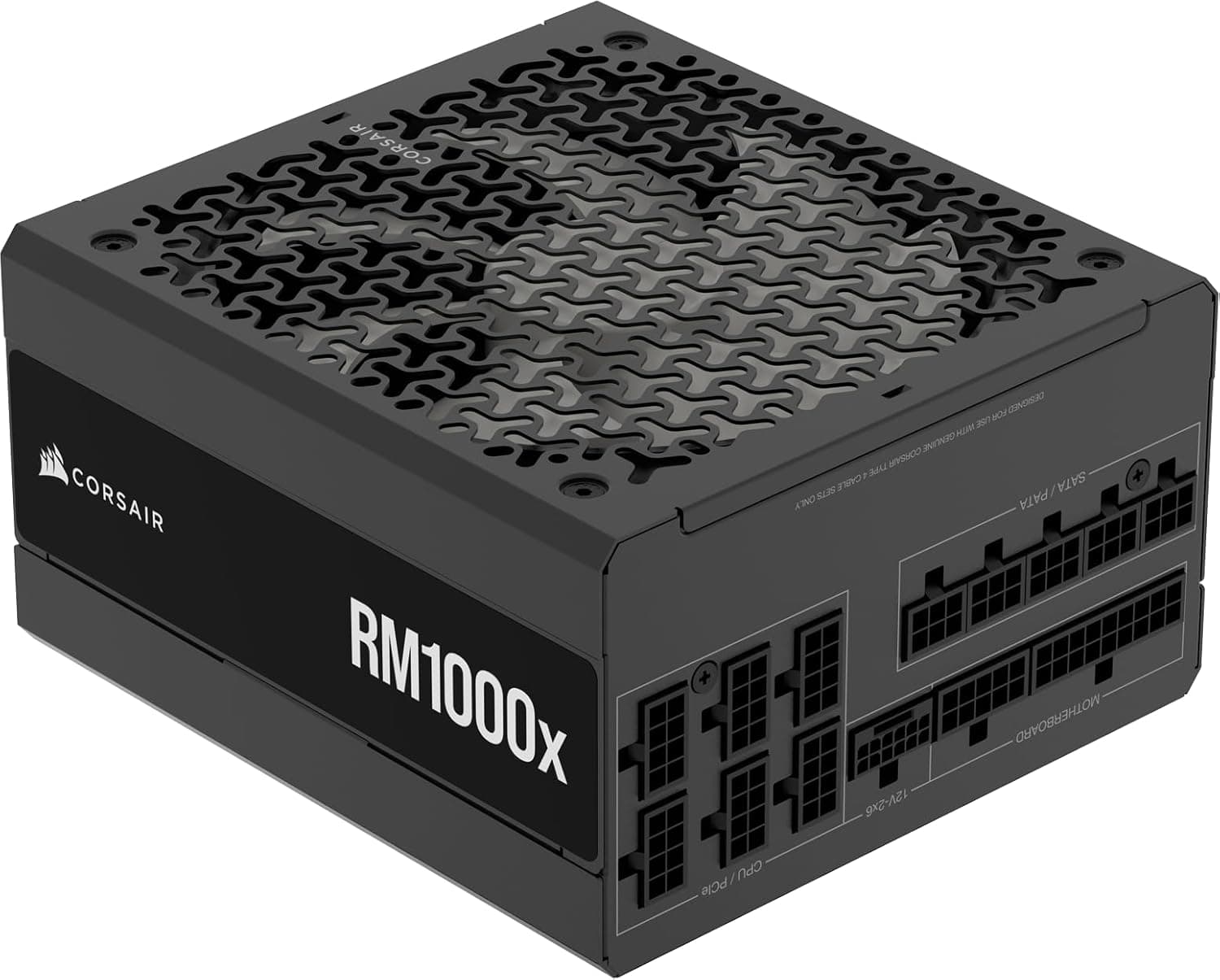
The Corsair RM1000x (2024) is worth it if you're building a high-end gaming or workstation PC with power-hungry components like RTX 4090s or Ryzen 9 7950X processors. At $126, this 1000W fully modular PSU delivers enterprise-grade reliability, 91% efficiency, and future-proof ATX 3.1/PCIe 5.1 support—but it's overkill and wasteful for mid-range systems drawing under 750W.
Corsair's RM1000x maintains the modular design philosophy that made the original RM series legendary. Every cable is detachable, letting you connect only what your system needs. This isn't just convenience—it directly impacts case airflow and aesthetics. The ATX form factor fits standard tower cases without issues.
The build quality screams enterprise-grade. The unit features a single 135mm FDB fan that operates passively under light loads (below 20% capacity), keeping your system silent during everyday browsing or office work. The housing is solidly constructed, and internal capacitors are rated for extended lifespan.
Cybenetics Gold certification isn't marketing fluff—it means this PSU maintains 91% efficiency at 50% load, one of the highest ratings available. In practical terms: a system drawing 500W will consume only 549W from your wall outlet, not 600W+. Over years of operation, that efficiency difference translates to lower electricity bills and reduced heat output.
The 1000W capacity is the critical spec here. Let's contextualize:
ATX 3.1 and PCIe 5.1 readiness means this PSU won't become obsolete when next-gen GPUs arrive. The 12V-2x6 connector standard (replacing traditional 8-pin PCIe connectors) is already appearing on high-end cards, and this unit supports both legacy and new standards.
Real-world testing shows voltage regulation stays within ±3% across all rails under load—excellent stability for overclocking. The 10-year warranty backs Corsair's confidence in component longevity.
Buy this PSU if:
Skip it if:
Compared to the EVGA SuperNOVA 1000W G6 ($120): Corsair's RM1000x edges ahead with slightly better efficiency (91% vs. 90%) and more robust capacitor selection. The EVGA is a solid alternative if you find it on sale.
Vs. the Seasonic Prime 1000W Titanium ($180): Seasonic's Titanium unit hits 94% efficiency but costs $54 more. For most users, the RM1000x's Gold rating delivers 90% of the benefit at 70% of the price.
Vs. 750W Gold alternatives (Corsair RM750x, $90): If your system truly maxes at 650W, a 750W unit is smarter. You'll save $36 upfront and operate in the 65-85% load range where efficiency peaks. Only jump to 1000W if you have genuine high-end components.
The Corsair RM1000x (2024) is a premium, future-proof PSU that excels in high-end builds. Its 91% efficiency, fully modular design, passive cooling, and ATX 3.1/PCIe 5.1 readiness justify the $126 price for enthusiasts. However, it's wasteful overkill for mid-range systems—don't buy it just because it's available. Match your PSU to your actual power draw plus 20% headroom. For RTX 4090 or RTX 5090 builds, it's genuinely worth it. For RTX 4070 systems, save money and buy a 750W unit.
No. An RTX 4080 + Ryzen 9 7900X system draws 650-700W under load, making 1000W provide appropriate headroom (30-35%) for stability and efficiency. However, a 850W unit would suffice and cost less.
Yes. The RM1000x includes ATX 3.1 and PCIe 5.1 support, meaning it's compatible with 12V-2x6 connectors on next-gen GPUs. However, it also includes legacy 6+2 pin connectors for older cards.
At 500W system draw, a 91% efficient PSU consumes 549W from the wall vs. 583W for an 85% efficient unit. Over one year (assuming 8 hours/day at $0.12/kWh), that's roughly $18 saved annually—modest but real over 10 years.
Yes. Below 20% load (~200W), the fan stops entirely. For light gaming, browsing, or office work, the unit runs completely silent. The fan engages smoothly under load without annoying ramp-up.
Absolutely. Voltage regulation stays within ±3% across all rails, and the 150W headroom above typical system draws provides stability cushion for overclocking spikes. The 10-year warranty also covers overclocked systems (within reasonable limits).
Get the best deals and reviews in your inbox.
We respect your privacy. Unsubscribe anytime.